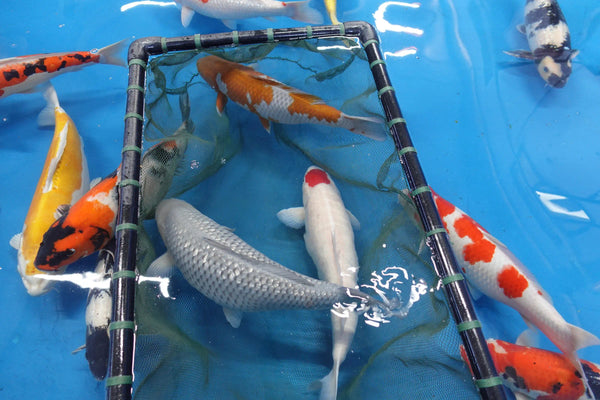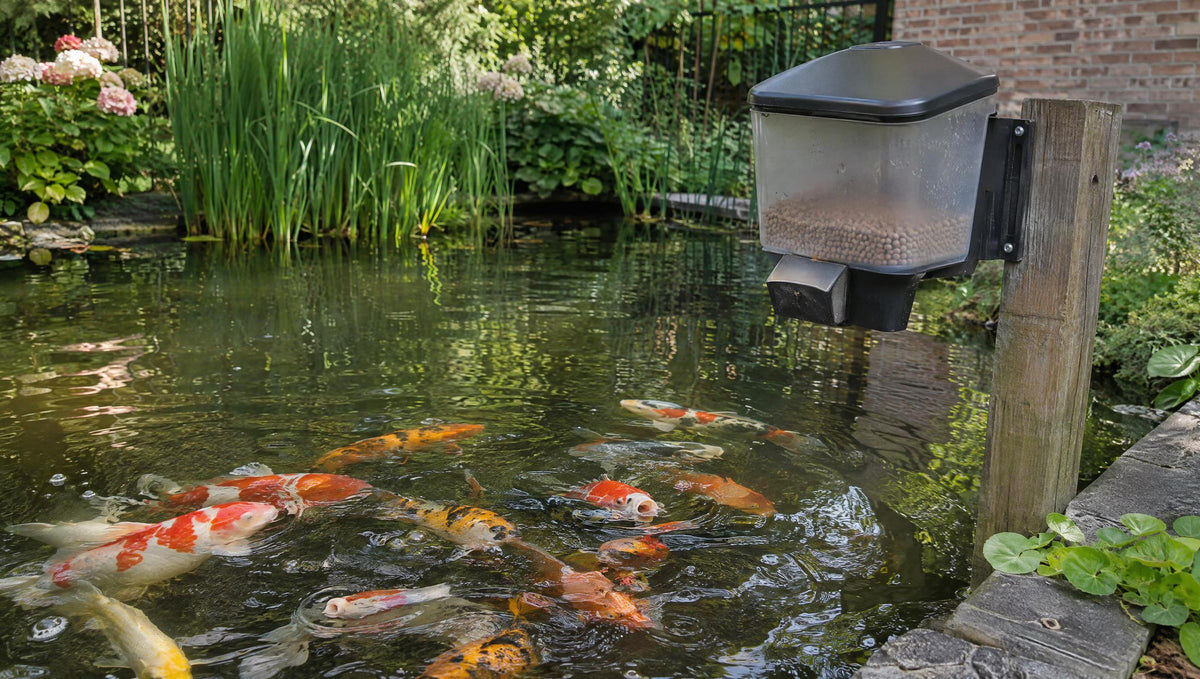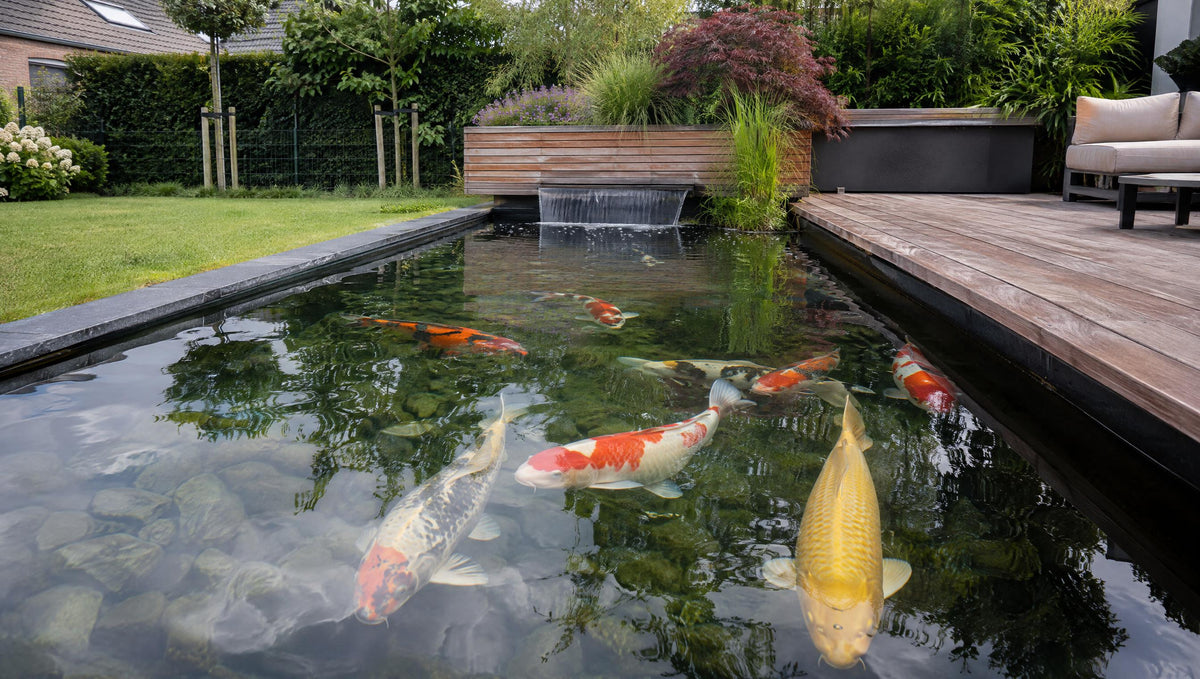


"Is there a food to boost koi growth?" The question is legitimate when you see your fish growing less quickly than those in another pond. Appropriate feeding can support their development, but no bag of pellets guarantees a specific size or a set number of centimeters per month. Age, the fish's potential, and maintenance conditions all play a role together.
The useful goal is to identify what is limiting your pond, then improve feeding without exceeding its capacity. Here is how to choose a food and evaluate its effects with concrete benchmarks.

Why don't two koi grow at the same speed?
Comparing their length only at the time of purchase is not enough. Fish of similar size may have different ages and backgrounds. Genetics also contribute to development potential. Therefore, a food will not transform all koi into competition-grade fish.
Environmental conditions count just as much. In an outdoor pond, temperature and the duration of the active season change throughout the year. A comparison with fish kept in a heated facility and monitored by a breeder can create unrealistic expectations. To evaluate your own situation, first compare observations taken in your pond, with their dates and temperatures.
You must also distinguish between regular growth and an abnormal change in body shape. A rapidly swelling belly, raised scales, or a fish that loses its balance do not indicate a good response to the food. In such cases, check the water and seek veterinary advice appropriate for fish.
What a "growth" food can provide
A food intended for growth seeks to provide the necessary nutrients for development under given usage conditions. Its composition, size, storage, and acceptance by the fish are all important. The word "growth" on the bag does not replace reading the label.
Do not choose based solely on the percentage of protein. The overall formulation and intended use must correspond to your fish and the water temperature. Food intended for a growth phase in warm water should not automatically be used at the same rate when the pond cools down.
Also ask whether the food constitutes a main ration or a supplement. A treat distributed regularly should not take the place of an adapted diet. When changing ranges, keep track of the product and quantities so you can appreciate the transition.
Aquifood: choosing the size and period of use
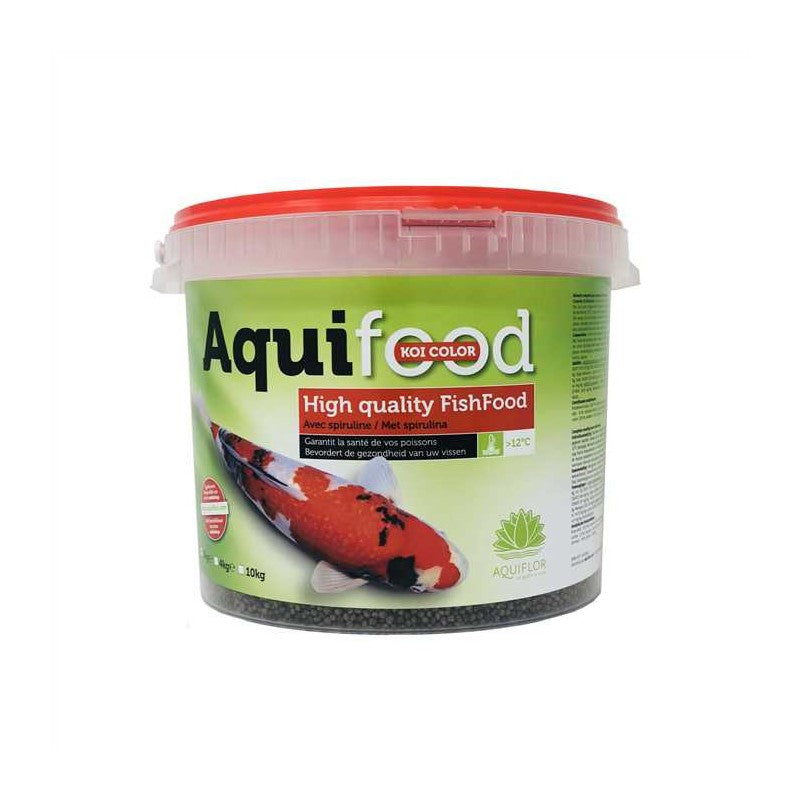
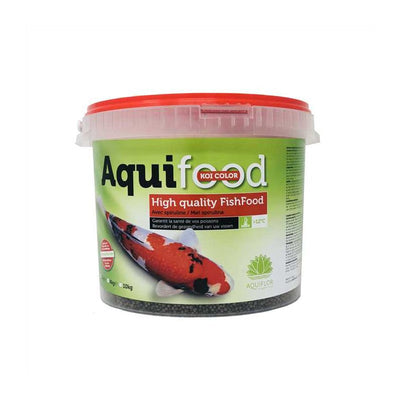
The Aquifood Koi Color & Growth range is presented by Aquiflor in several pellet diameters. The choice must follow the fish's actual ability to swallow their food. A 2–3 mm size can be practical for young koi that are already developed; it remains too large for recently hatched larvae.
Aquifood Koi Color & Growth in 500 g allows you to have a modest package. The Mini 2–3 mm 2 kg format meets higher consumption needs. The data sheet for this food indicates use when water exceeds 12 °C; this limit must be considered in relation to appetite and pond conditions.

The presence of spirulina is one of the advertised features. It does not justify promising protection against diseases or identical growth in all fish. Keep the bag closed, in a dry place, and according to the manufacturer's instructions. A large reserve stored poorly provides no advantage.
Increasing meals without increasing problems
When temperature, koi activity, and filtration allow, splitting the ration helps provide quantities that are easy to consume. Start by measuring what you are already distributing. Several small handfuls added by different people can represent much more than expected.
Then observe the entire meal. Does every fish get access to food? Are the larger ones monopolizing a distribution point? Do pellets go directly to the skimmer? Spreading a small amount across several accessible areas can be more useful than pouring more in the same spot.
Remove leftovers and reduce the next amount if the food is not consumed. An automatic feeder requires the same vigilance: set it based on a truly measured quantity and verify its operation with the pellets used. It facilitates a routine, but does not detect a drop in appetite or a water quality problem.
Filtration sets a concrete limit
An increase in food increases the load that the pond must process. Before significantly changing the ration, check the flow rate, the cleanliness of the pre-filter, and the operation of the aeration. Check ammonium/ammonia and nitrites, then continue this monitoring after the change.
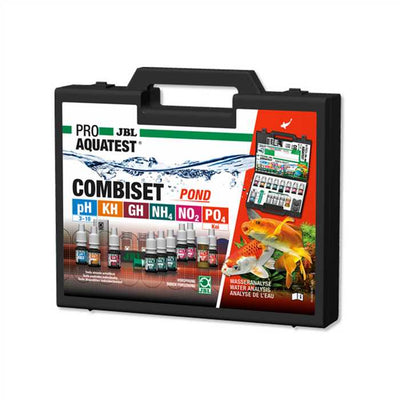
The JBL ProAquaTest CombiSet pond helps particularly in monitoring these nitrogen parameters, pH, and hardness. If results deteriorate, first look for why the system is not keeping up. Adding a richer food is not the answer to the desired growth.
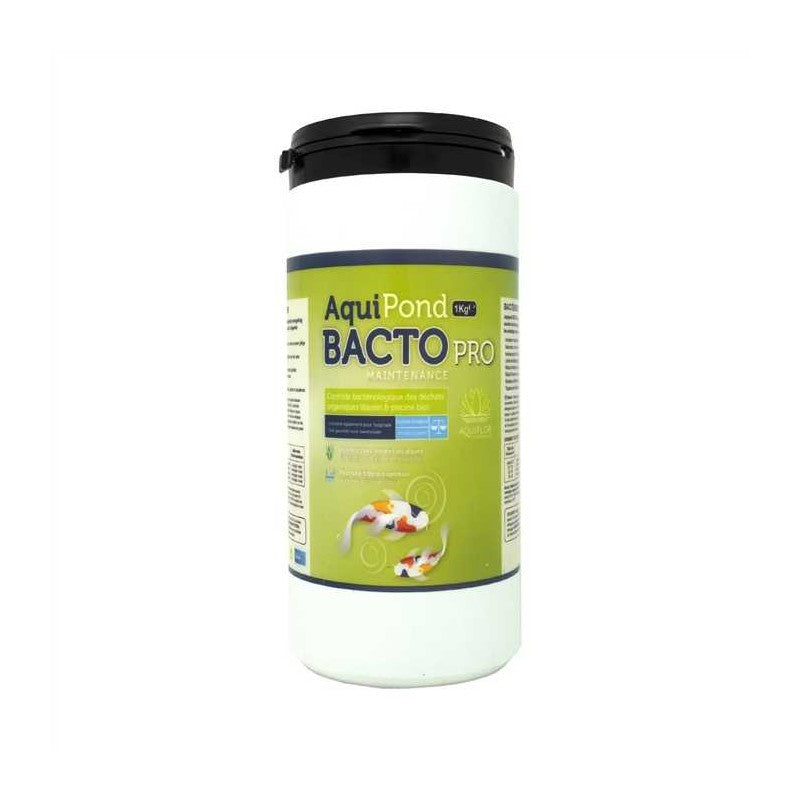
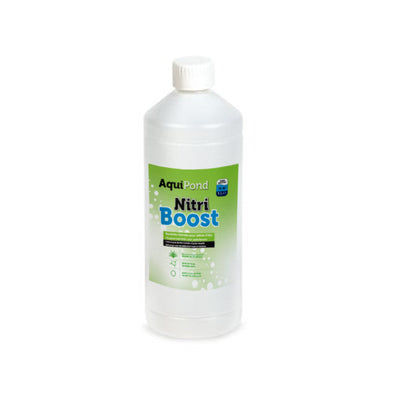
Aquipond NitriBoost for ponds can support biological filtration according to its instructions. It does not permanently compensate for an excessive population, insufficient flow, or an accumulation of waste. Maintenance capacity and filter operation must remain consistent with feeding.
Temperature: monitor water and appetite
The daytime air temperature does not describe the pond's temperature over twenty-four hours. Use a thermometer and observe trends, especially in spring and autumn. A sunny day after several cold nights is not enough to abruptly restart a summer ration.
Manufacturers provide usage ranges specific to their foods. Respect those of the chosen product and adapt quantities if the fish are eating less. During high heat, illness, or water problems, seeking growth comes second to restoring suitable conditions. Do not heat a pond just to follow a growth chart found on the internet.
Simple tracking to know what works
Create a monthly sheet with four sections: food used, approximate quantity distributed, observed temperatures, and water tests. Add a photograph of the fish in comparable conditions. This method brings more value than an imprecise memory that they were eating "much less before."
Avoid repeated captures just to measure a few millimeters. If handling is necessary for another reason, ask how to perform it correctly and take the opportunity to note useful information. Monitoring should remain proportionate to your pleasure pond project.
| Observation | Priority verification |
|---|---|
| Only one fish stays small | Access to food, general condition, and history of the fish. |
| The whole group eats less | Temperature, water, oxygenation, and recent changes. |
| Ration increases but waste accumulates | Quantities, particulate removal, and filtration capacity. |
| Fish eat well and water remains monitored | Continue a stable routine, without seeking permanent acceleration. |
Adjust your koi's diet with Aquiflor: indicate their size, your water volume, temperatures, and the filter reference. These elements will allow for advice on food within the real context of your pond.