

Yes, koi carp can be introduced in November, provided the water does not freeze and the fish does not suffer from thermal shock. This is even the season when Japanese breeders take their koi out of the ponds and European importers bring in their lots.
Every autumn, the same question comes up: “It’s too cold to put fish in, isn’t it?” The idea is widespread, but it mixes two things. Cold does not kill a koi; what weakens it is a sudden change in temperature, dirty water, or a fish that is already sick. Here is what breeders and veterinarians say, and what really needs to be monitored.
In Japan, the koi season is autumn
In the Niigata region, the birthplace of koi, breeders empty their mountain ponds of mud from October to December: this is the ikeage, the harvest. By tradition, many start around October 15, and the fish then spend the winter in protected buildings, until April (Koi Water Garden, Japanese Ministry of Tourism).
It is therefore in October and November that buyers from around the world travel to Japan: the choice there is the widest of the year (Pond Trade Magazine, ChampKoi). European importers also ship lots in late October, put on sale in late November after quarantine (Cotswold Koi).
Another telling detail: after the harvest, many Japanese breeders keep their koi around 12 °C all winter, without feeding them (Nishikigoi Digest International). Cool water is nothing unusual for these fish.
Why water at 8-12 °C facilitates transport
To move a koi, cool water has three concrete advantages in the summer heat.
- More oxygen. Water at 10 °C contains about 11.3 mg/L of oxygen, compared to 8.2 mg/L at 25 °C (Euro-Matic). In summer, the lack of oxygen is one of the first factors of stress, especially in a transport bag.
- A slowed metabolism. In cool water, the fish is calmer, consumes less oxygen, and releases fewer waste products during the journey (Fitz's Fish Ponds).
- The KHV virus dormant. Koi herpesvirus, the most feared disease, triggers its outbreaks especially between 16 and 25 °C (University of Florida, IFAS, Australian Ministry of Agriculture). Note: cold does not make the virus disappear, it only prevents it from manifesting. Hence the importance of buying from a serious supplier.
The real conditions for success
The weak point of autumn is not the cold itself, but the koi's immune system, which slows down below around 12 °C (Euro-Matic, Fishdoc). You must therefore avoid anything that adds stress.
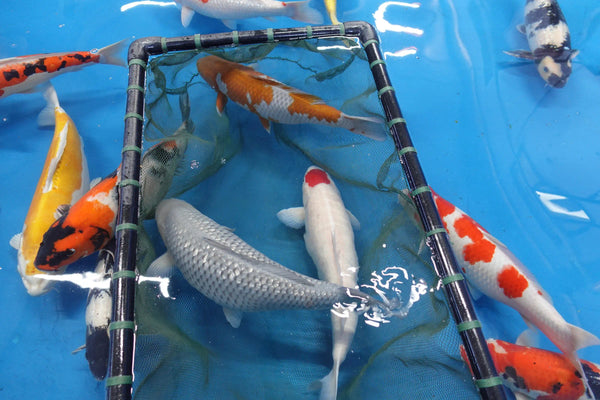
- No thermal shock. The water in the bag and that of the pond must have almost the same temperature: a few degrees of difference at most. Float the bag 20 to 30 minutes before releasing the fish. A koi that has spent the autumn outside tolerates 10 °C water much better than a koi taken out of a heated tank.
- A pond that does not freeze. Introduce your fish as long as the water remains liquid and stable, ideally between 8 and 12 °C.
- No food. Around 10 °C, the koi stops feeding (Euro-Matic). There is no need to feed it upon arrival. To go further: when to stop feeding pond fish in autumn?
- Clean and oxygenated water. Opportunistic bacteria such as Aeromonas take advantage of water loaded with organic matter (Mid-Atlantic Koi Club). Keep the filter clean and an aeration system running.
- A quarantine if you already have fish. Isolating the newcomers for a few weeks prevents contaminating the rest of the pond (Cuttlebrook Koi Farm).
The major reference Japanese breeders
The judge of peace in the sector is the All Japan Nishikigoi Show, organized every year since 1968 and considered the most prestigious koi competition in the world (Fitz's Fish Ponds). These breeders constantly return to the winners' list.
| Breeder | Region | Specialties | Notable fact |
|---|---|---|---|
| Sakai Fish Farm | Hiroshima | Kohaku, Sanke | 13 Grand Champion titles at the All Japan between 2000 and 2024 (ChampKoi) |
| Dainichi Koi Farm | Ojiya, Niigata | Showa, Kohaku, Sanke | Grand Champion notably in 2012, 2020 and at the 56th All Japan (Kodama, Fitz's) |
| Isa Koi Farm | Niigata | Showa | Grand and Supreme Champion at the Niigata breeders' show in 2013 (Pond Experts) |
| Omosako Koi Farm | Japan | Showa | Superior Champion at the All Japan 2020 (Kodama) |
| Momotaro Koi Farm | Okayama | Kohaku, Sanke | Supreme Champion at the All Japan 2013 (Pond Experts) |
| Marudo Koi Farm | Niigata | Kohaku, Sanke | Lineage from Dainichi, regularly awarded at the All Japan (Kodama) |
| Shinoda Koi Farm | Niigata | Ginrin Showa, Doitsu | Grand Champion at the Niigata breeders' show in 2000 (Kodama) |
These names count for a simple reason: the broodstock of these lineages are found today with breeders around the world, including Europe.
Our koi: Japanese lineages, raised near you
At Aquishop, our koi carp today come essentially from Belgian and French breeders, from Japanese broodstock. They grow up in a climate close to yours.
We also offer many other pond fish, and we deliver our live fish within a radius of 150 km around Nodebais. Are you hesitating on a variety, a size, or the right time for your pond? Write to us: we will advise you according to your water temperature.
Frequently asked questions
Can koi be put in a pond in November?
Yes, if the water does not freeze and if the fish does not suffer from thermal shock: a few degrees of difference at most between the water in the bag and that of the pond.
Should a koi introduced in autumn be fed?
No. Around 10 °C, the koi stops feeding. Wait until the water rises sustainably in spring before resuming small rations.
Does the cold protect koi from KHV?
It mainly prevents the virus from manifesting: outbreaks occur especially between 16 and 25 °C. Cold does not make the virus disappear, hence the importance of a serious supplier and a quarantine.
Do you deliver koi carp?
Yes, we deliver our live fish within a radius of 150 km around our store in Nodebais.
Any doubts? Bring a water sample to Nodebais: the analysis is free.
Call 010 86 03 54Write to support@aquiflor.com