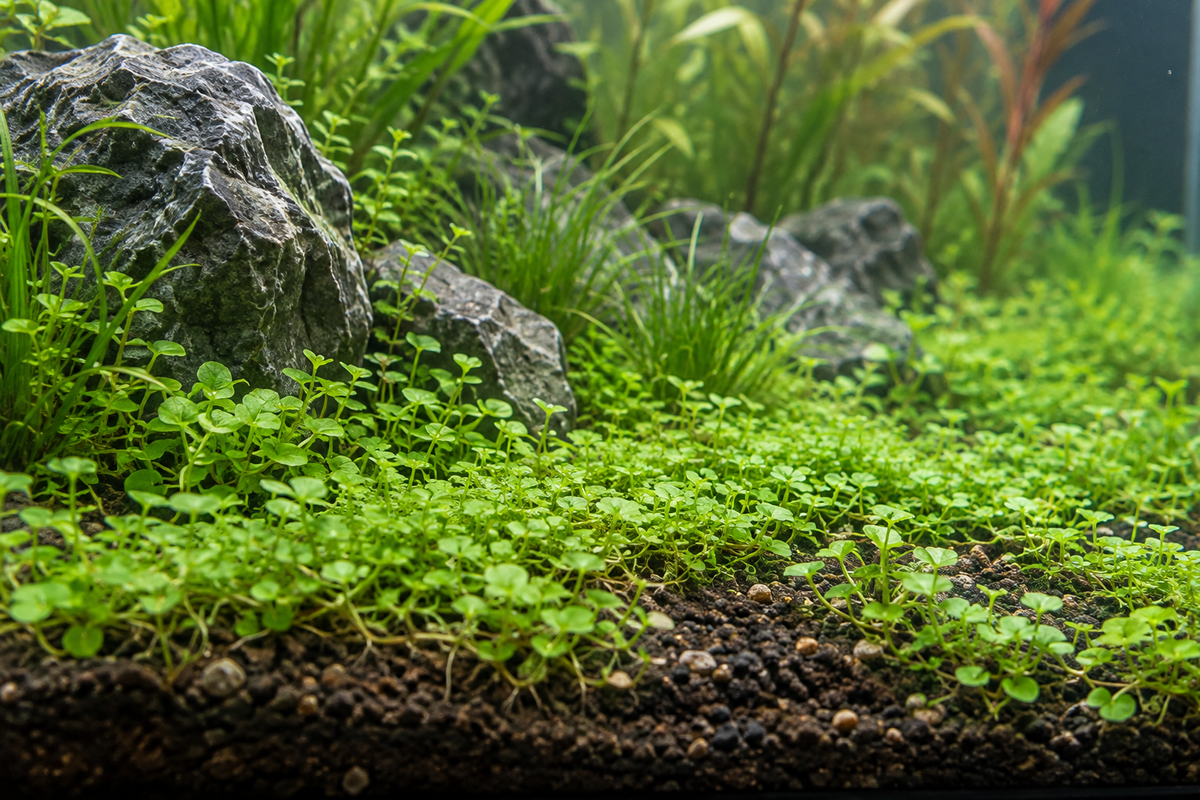
A carpet of vegetation gives an aquarium depth and highlights rocks or roots. However, not all carpeting plants have the same requirements. The result depends as much on the choice of species as it does on the lighting, soil, planting, and maintenance.
To succeed with your first carpet, choose a plant suited to your aquarium's capabilities and accept a gradual installation. A small, well-rooted area will be easier to manage than an entire bottom covered with an overly demanding species.

What is a carpeting plant?
In aquascaping, the term refers to plants used to form a low-growing cover in the foreground. Some develop small, round leaves on creeping stems; others produce thin, upright leaves that resemble a miniature meadow.
The term describes a desired effect, not a unique botanical group. Two plants sold as carpeting species can have very different heights, growth rates, and needs. Therefore, look at the specific name, including the variety when indicated.
A living carpet evolves. It may become denser, spread onto a patch of sand, or need thinning. Plan for access for trimming and waste removal from the start.
Three plants to compare based on your project
| Plant | Desired appearance | Point to consider before purchasing |
|---|---|---|
| Marsilea hirsuta | Leafy cover whose shape varies with conditions | Relatively modest needs, but variable height and appearance |
| Micranthemum tweediei ‘Monte Carlo’ | Small rounded leaves, light green carpet | Good lighting and CO₂ supply to achieve a particularly compact carpet |
| Eleocharis pusilla ‘Mini’ | Thin leaves, small meadow effect | Sufficient light at the substrate and conditions adapted to this specific reference |
Marsilea hirsuta: accepting an evolving result
Tropica presents Marsilea hirsuta as a carpeting plant with low light and CO₂ requirements. Its leaves can change shape after installation and may have one or more lobes. It is an interesting candidate when you are looking for a planted foreground without necessarily aiming for a perfectly uniform, low-cut carpet.
The result depends on the growing conditions. Do not choose this plant based solely on the height shown in a photograph: ask what look to expect in your tank, with your lighting and your soil.
‘Monte Carlo’: a carpet of small leaves
Micranthemum tweediei ‘Monte Carlo’ offers rounded, light-colored, creeping foliage. Tropica classifies its light and CO₂ needs as medium and specifies that good lighting combined with CO₂ promotes compact growth.
Its maintenance is worth anticipating. A layer that has become too thick can lift off when the underside degrades. Proper trimming and collecting the cut pieces help maintain a more regular structure.
Eleocharis pusilla ‘Mini’: a meadow effect
This plant produces thin, short leaves. Tropica generally indicates a range of 3 to 5 cm, with possible variation depending on cultivation, and medium light and CO₂ needs. It should be planted in small portions spread over the area to be covered.
Check the full name when purchasing. Not all Eleocharis stay this low: another species or variety can significantly alter the proportions of your layout.
Assessing the light that actually reaches the bottom
A light fixture sometimes appears very bright when viewed from above, while the foreground remains shaded by tall plants or a large root. Observe the area where you want to install the carpet. The depth of the tank, the position of the fixture, and any obstacles all count.
Do not directly translate an old wattage-per-liter ratio to just any LED fixture. To compare equipment, examine the manufacturer's recommendations and, when available, the light data measured at the relevant depth.
Significantly extending the lighting duration does not automatically correct poorly distributed light. Use a stable schedule and adjust settings gradually, taking into account all the plants and animals.
Preparing a substrate compatible with planting
The substrate must allow for the anchoring of small portions. A very coarse soil can make this step difficult. Before changing the bottom, also check the intended use of the product: some technical soils influence water parameters and require a specific startup protocol.
In an already inhabited aquarium, avoid redoing the entire substrate just to test a small carpeting plant. Start by evaluating the possibility of a limited area. Existing roots, decor stability, and the needs of bottom-dwelling fish must be part of the decision.
Sketch the area to be covered before purchasing. A clear border for siphoning or a sand patch can be useful. The carpet does not need to occupy every centimeter of the bottom to be visually successful.
Planting in small portions
- Prepare the plants according to their packaging: pot, growing medium, or in-vitro cup. Follow the producer's instructions for removing the medium or gel.
- Divide the clump into small, manageable portions, without reducing each fragment to a fragile, isolated root.
- Distribute the portions over the intended surface, leaving space for them to grow.
- Use suitable tweezers to anchor them gently, avoiding burying the entire foliage.
- When setting up a new tank, fill it gently so as not to uproot the plants.
Prepare your tools and water before taking the plants out of their packaging. Keep them moist while working. If a portion comes loose, replace it without disturbing the entire surrounding area.
Providing the right tools for trimming

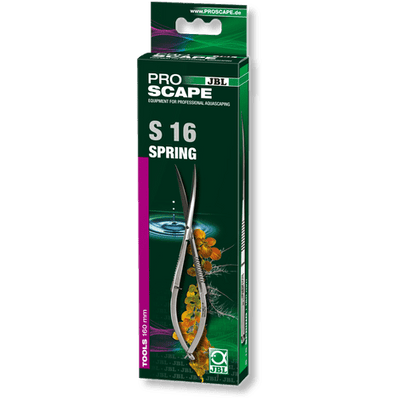
The JBL ProScape Tool S 16 spring are 16 cm curved spring scissors, designed especially for mosses and carpeting surfaces. Choose a tool that you can handle with precision at the depth of your aquarium.
Trim according to the species and root development, then collect the fragments. A small net and a suitable siphon will complete the job. Keep your tools clean and use them exclusively for aquarium maintenance.
CO₂ and fertilization: adapt rather than multiply
A CO₂ supply can support demanding plants, but it requires mastered equipment and settings. The injection rate of another aquarium is not a figure that can be transferred to yours. Animal safety and water stability remain the priority.
For fertilization, consider the substrate, plant mass, and existing nutrient inputs. A plant that is growing poorly does not necessarily need a stronger dose. Lighting, rooting, and water parameters may also be limiting its development.
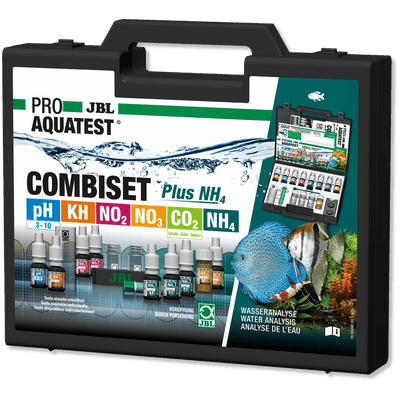
The JBL ProAquaTest CombiSet Plus NH4 is helpful for monitoring pH, KH, and nitrates, as well as nitrites and ammonium. To check other elements, choose the complementary tests useful for your project.
What to do if the carpet doesn't take?
Start by distinguishing between an anchoring problem and a growth problem. Portions that float right after planting require better-adapted fixation. Plants that are established but are etiolating (stretching) suggest a need to examine the light at the bottom and the growing conditions.
Remove decaying parts and watch for new growth. Avoid changing several settings at once. Take a weekly photo from the same angle: it helps to see progress that is sometimes difficult to perceive on a daily basis.
If fish are constantly uprooting the portions, reconsider the layout. A fragile carpeting plant may be incompatible with their behavior. Adapting the decor to the inhabitants is often more sustainable than replanting constantly.
Preparing your purchase with Aquishop
The species presented are suggestions, and their availability must be confirmed. To prepare planting and maintenance equipment, contact the Aquiflor team with the tank dimensions, lighting reference, type of soil, and the possible presence of a CO₂ injection system.
The best start is a plant compatible with your setup and a surface area that you can maintain easily. Have these points validated before ordering large quantities.