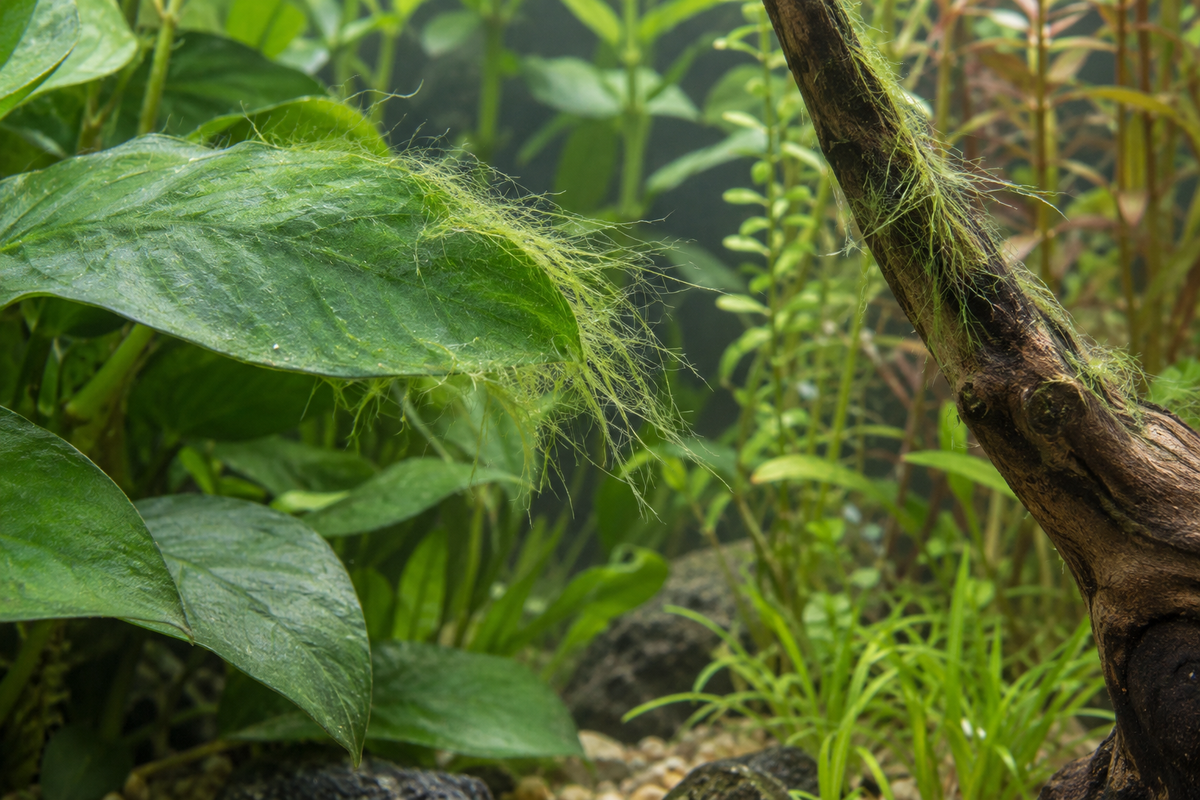
Filamentous algae cling to leaves, mosses, and roots, forming strands that sometimes return after every cleaning. To reduce them in the long term, you must act on two fronts: remove the existing mass and understand what is promoting its regrowth.
Start with precise maintenance, then adjust the tank conditions based on observations and measurements. No single action guarantees the permanent absence of filaments, but a regular method allows for better control of their development.

Recognizing filaments without putting everything in the same category
The term "filamentous algae" brings together various organisms that appear thread-like. Some are thin and flexible, while others are more firmly attached. Their color and texture do not always allow for precise identification with the naked eye.
Photograph the area and observe the colonized surfaces. Threads on moss, a slimy mat on sand, and uniformly green water require different checks. If the appearance corresponds more to a continuous layer, refer to the guide to slimy deposits.
Also, look at the extent of the problem. A small, isolated tuft does not automatically justify treating the entire aquarium. On the other hand, plants that are largely choked require a more organized intervention.
Preparing a removal session
Before starting, prepare a container for waste, a small brush reserved for the tank, tweezers, a net, and possibly a suitable siphon. Prepare replacement water if the maintenance involves removing some.
Locate any animals in the areas to be worked on, especially fry and shrimp. Take the time to clear a limited zone rather than pulling a large mass that carries away several plants.
If an intervention requires unplugging a device, follow its instructions and put it back into service correctly after maintenance. Do not leave a filter turned off during a long session simply because its outflow is slightly interfering with your movements.
Rolling, removing, and collecting fragments
Flexible filaments can often be gently rolled around a small brush or a bottle brush. Support fragile plants to avoid uprooting them. If the algae resist, do not force them to the point of tearing all the leaves.
Regularly take out the tool to remove the collected matter into a container. A loaded brush shaken in the aquarium puts fragments back into circulation. Collect anything that floats with a net or controlled suction.
Work methodically: one root, one group of plants, then the next area. This organization allows you to see where the filaments remain attached and to compare their return during the next maintenance session.
When to prune an invaded plant?
A very damaged or almost entirely covered leaf can be removed if it suits the plant. However, evaluate the amount of remaining foliage. A radical pruning of all plants reduces their ability to recover and changes the tank significantly.

The JBL ProScape Tool S 16 spring scissors are particularly suitable for mosses and small carpeted areas. Their curved shape allows for localized work. Check that their length corresponds to the access in your tank.
After pruning, collect the cut pieces. Take this moment to check if waste is accumulating in a tuft that is too dense or behind a decorative element.
Searching for inputs that sustain regrowth
Observe a full meal. Does the food reach the targeted fish? Does a portion always fall in the same place without being consumed? Are several people each distributing a ration? A small change in organization can avoid unnecessary input.
Also, examine the new water, fertilizers, and plant waste. In a planted tank, nutrients are necessary, but their intake must match the needs. Stopping all fertilization without knowing what is missing or accumulating can weaken the plants.
Note what you actually add, in terms of quantity and frequency. This list is more useful than a vague estimate when asking for advice.
Measuring before correcting nitrates or phosphates
Monitoring nitrates and phosphates helps to examine the balance of inputs. It does not, on its own, allow you to attribute each filament to a specific element. The algae present also consume nutrients, and a measurement represents a given moment.
The JBL ProAquaTest CombiSet Plus NH4 includes nitrates, pH, KH, nitrites, and ammonium. Complement it with a phosphate test if necessary. Record the units and use the reagents according to their instructions.
If an excess of phosphates is established, the JBL PhosEx rapid for freshwater aquariums may be an option to consider. Its use must take into account the plants and current instructions. Simultaneously, look for the origin of the input to avoid depending on repeated correction.
Adjusting light without changing all settings
Check the timer first. An illumination schedule set for a limited duration may remain on for much longer after manual handling. Then observe the exposure to sunlight and the areas where the light bar shines most strongly.
A reasoned reduction in duration or intensity can be part of the plan, depending on the plants present. Change one identifiable setting and note it. A heavily planted aquarium with CO₂ injection does not have the same constraints as a dimly lit tank with a few slow-growing plants.
To learn more, see our article on the role of lighting in algae problems. Turning the tank off for a long time is not a universal solution for filaments.
Maintaining functional biological filtration
Remove waste from the pre-filter and check the flow rate according to the manufacturer's instructions. Preserve the colonized biological media. A major simultaneous cleaning of the substrate, filter, and decor can destabilize the installation.
A UV clarifier acts on what circulates in its chamber. It does not directly remove filaments attached to leaves. Its potential value should be evaluated according to the cloudiness present, without replacing removal efforts and the search for causes.
If you have any doubt about a drop in flow, provide the exact reference of the filter and a photo of its assembly. A worn part, a pinched hose, or a clogged pre-filter require different answers.
Shrimp and algae-eating fish: choosing inhabitants for their needs
Certain animals consume certain algae, but they do not eat all filaments and do not eliminate the need for maintenance. Their introduction must be compatible with the volume, parameters, other species, and the maturity of the tank.
Do not choose a fish solely for a cleaning function. Check its adult size, diet, and behavior. It will still need appropriate food and care once the algae have decreased.
Managing the potential use of a product
An anti-algae product should be chosen according to its indication and the population. For JBL Algol, the manufacturer notes a possible sensitivity of dwarf shrimp and certain mosses. Consult the current instructions and ask for advice if your tank contains them.
Avoid mixing products and doses calculated based on the exterior volume of the tank. Provide for oxygenation and the removal of matter according to the chosen protocol. Do not use a pond treatment in an aquarium without explicit instructions for this use.
Verifying that regrowth is slowing down
Choose two reference zones and photograph them after each maintenance session. Note the date of removal, the modified settings, and the analyses. The goal is to know if the filaments return more slowly and if the plants are growing better.
If the situation stagnates, send these details to the Aquiflor team. A simple history allows you to examine the next step with more precision than a list of products tried without dates.