Are you looking for nitrifying bacteria to start an aquarium or to support its filter after maintenance? You can find suitable activators from an aquarium specialist and on Aquishop. The choice should first be based on the intended use, the type of water, and the product instructions. Simply searching for "Nitrobacter" is not enough to identify the right reference.
Here are the criteria that will help you choose a useful bottle, plan the right dosage, and avoid purchasing products that address a problem other than the one in your tank.

Why look for a function rather than just a single bacterial name?
Nitrobacter refers to a genus of bacteria associated with the transformation of nitrites into nitrates. In an aquarium, the useful community is more diverse. Studies on freshwater biofilters highlight the role of Nitrospira, among others, some members of which ensure complete nitrification, as well as other microorganisms.
A commercial activator should therefore not be considered a pure culture of Nitrobacter unless the manufacturer provides this information. What you are concretely interested in is its field of application: accompanying startup, supporting biological recovery, or responding to a specific indication.
A nitrite test allows you to track a concentration in the water. It does not directly verify the identity of the strains contained in the bottle. Keep this distinction in mind when comparing commercial claims.
A first reference to consider: Aquipond Aquarium NitriBoost
Aquipond Aquarium NitriBoost 150 ml is a formula designed for freshwater aquariums. It is presented to support nitrification, particularly during setup and recovery from an imbalance. This is indeed a reference for aquariums, distinct from the NitriBoost canisters intended for ponds.
The product sheet indicates a startup dosage of 10 ml per 50 liters, every two days for two weeks. Before application, re-read the label on the packaging you received and verify the actual volume involved. The instructions should also guide you on storage after opening.

An activator accompanies a protocol. It does not automatically declare a tank mature nor allow for the immediate introduction of the entire desired population. The decision rests on the functioning of the system, analysis results, and progressive stocking.
Another possibility depending on the need: JBL Denitrol
JBL Denitrol 100 ml is presented as an activator containing bacteria and enzymes, with indications for freshwater and saltwater aquariums. Its use must follow its own instructions. The quantities specified for Aquipond Aquarium NitriBoost do not apply to Denitrol.
This difference in usage can matter if you have a saltwater aquarium. Do not choose a formula just because its packaging looks like a product you have already used. Explicitly verify the water type, the intended situation, and compatibility with any existing equipment or treatments.
It is not necessary to pour several brands simultaneously to "cover all the bacteria." This complicates dosing, instructions, and the interpretation of monitoring results. Choose a consistent method and keep track of applications.
Information to prepare before ordering
| Information | Usefulness for choosing |
|---|---|
| Freshwater or saltwater | Verify the formula's area of use |
| Approximate actual volume | Calculate the quantity needed for each application |
| Tank age and filter model | Distinguish between startup and disruption of an existing installation |
| NH4/NH3, NO2, pH and temperature | Describe the situation instead of choosing based solely on a symptom |
| Recent interventions and products | Identify an incompatibility or an ongoing cause |
If you do not know the exact volume of water, start from the interior dimensions and take into account the substrate, décor, and fill level. The commercial capacity listed for the aquarium is a benchmark, but does not always represent the amount actually present.
A photo of the filter and its connections can also be useful. A circulation problem is not solved by choosing a more concentrated bottle.
Compare the useful quantity, not just the bottle size
The number of liters stated on a product sheet may correspond to one application or a specific use. If the protocol requires several doses, you must add the quantities together. A quick calculation avoids running out of product in the middle of the program.
Example: with a dosage of 10 ml per 50 liters, an aquarium that actually holds 100 liters requires 20 ml per application. The total then depends on the number of applications specified by the instructions. The 150 ml in the bottle should not be mistaken for a complete program for 750 liters.
Also compare the equipment needed for monitoring. Buying an activator without having a suitable test makes it difficult to evaluate the result. The useful cost therefore includes the protocol and its checks, not just the price of the product.
Verify packaging and storage
Upon receipt, check the reference, the condition of the bottle, and the storage instructions. Keep the label and the instructions. If a date is unreadable or if the package shows an anomaly, contact the seller before use.
The Aquipond Aquarium formula specifies storage in a cool place away from light after opening. Do not turn this instruction into an invented specific temperature: follow the packaging details or ask for confirmation. Avoid leaving the bottle near the lighting fixture, in a hot car, or on an exposed windowsill.
Do not add water to the bottle to "extend" it. Use the doser as intended, close it properly, and keep the lot information. These simple steps also facilitate a request for advice later on.
Ordering online or asking for advice at Aquiflor?
The Aquishop sheet allows you to find the reference and its indications. Before ordering, re-read the usage and check the displayed availability information. An advisory article does not constitute a promise of permanent stock or delivery timeframe.
If your need is difficult to identify, contact Aquiflor in Nodebais with your measurements and project. For an in-store visit, check the opening hours and confirm the availability of the desired reference. This allows for a useful exchange and avoids traveling for an unsuitable product.
It is particularly useful to ask for advice if several treatments have been used, if the filter has undergone a prolonged breakdown, or if the water shows contradictory values. In these situations, the right purchase begins with an understanding of the problem.
Can you recover bacteria from another aquarium?
An already colonized medium from a healthy tank can contribute to seeding another system. This solution requires knowing the health status of the donor tank, preserving the medium, and not compromising its filtration. A sponge of unknown origin or randomly collected water do not offer the same guarantees.
The transfer must be prepared and monitored by analyses. It does not automatically provide a capacity suited to the entire future population. Do not collect mud from the natural environment to replace a identified activator.
Checks to continue after purchase
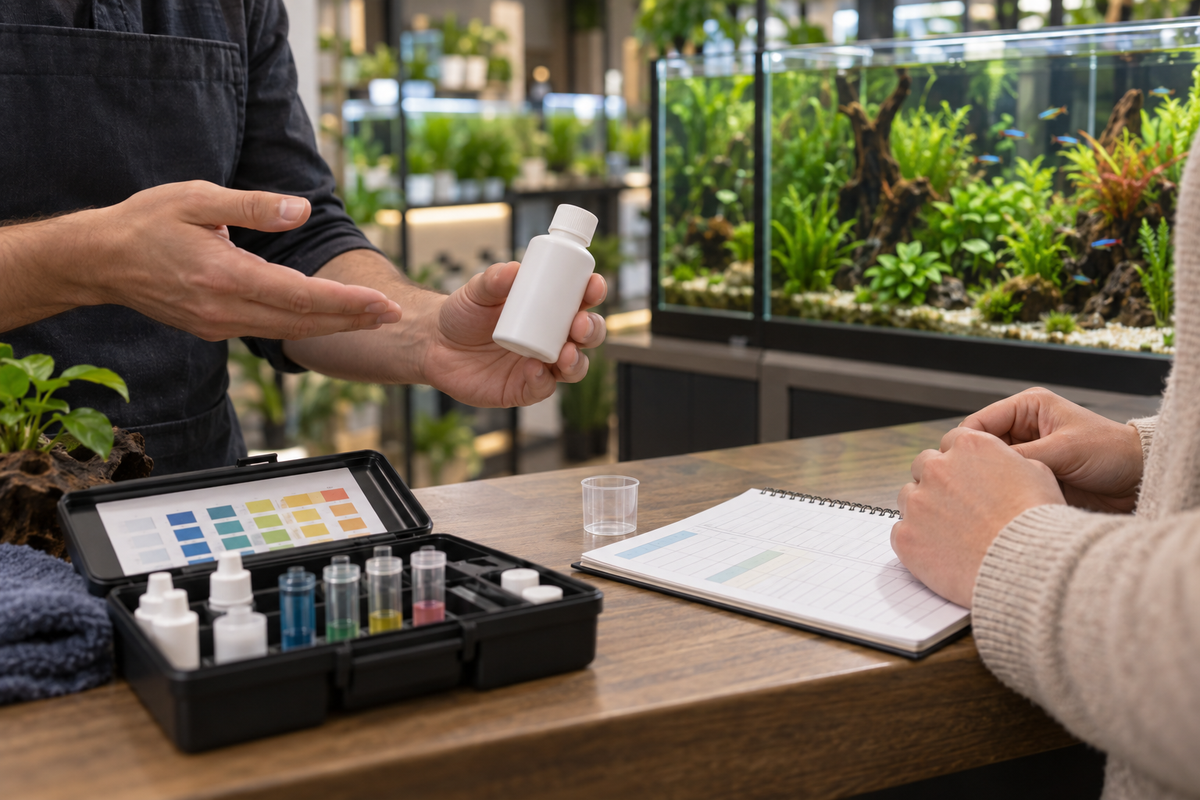
The JBL ProAquaTest CombiSet Plus NH4 brings together, in particular, measurements of ammonia compounds, nitrites, and nitrates, with pH and KH. Note the results and interventions to track the actual progress of the tank.
If nitrites are already present with fish in distress, the purchase of an activator should not delay water correction or a veterinary opinion. Restore filtration and aeration, then have the measures adapted to the situation. The bacteria will find their place in this context.
To start your selection, consult Aquipond Aquarium NitriBoost and prepare the volume, analyses, and description of your filter. You will have the necessary elements to choose a consistent reference and protocol.