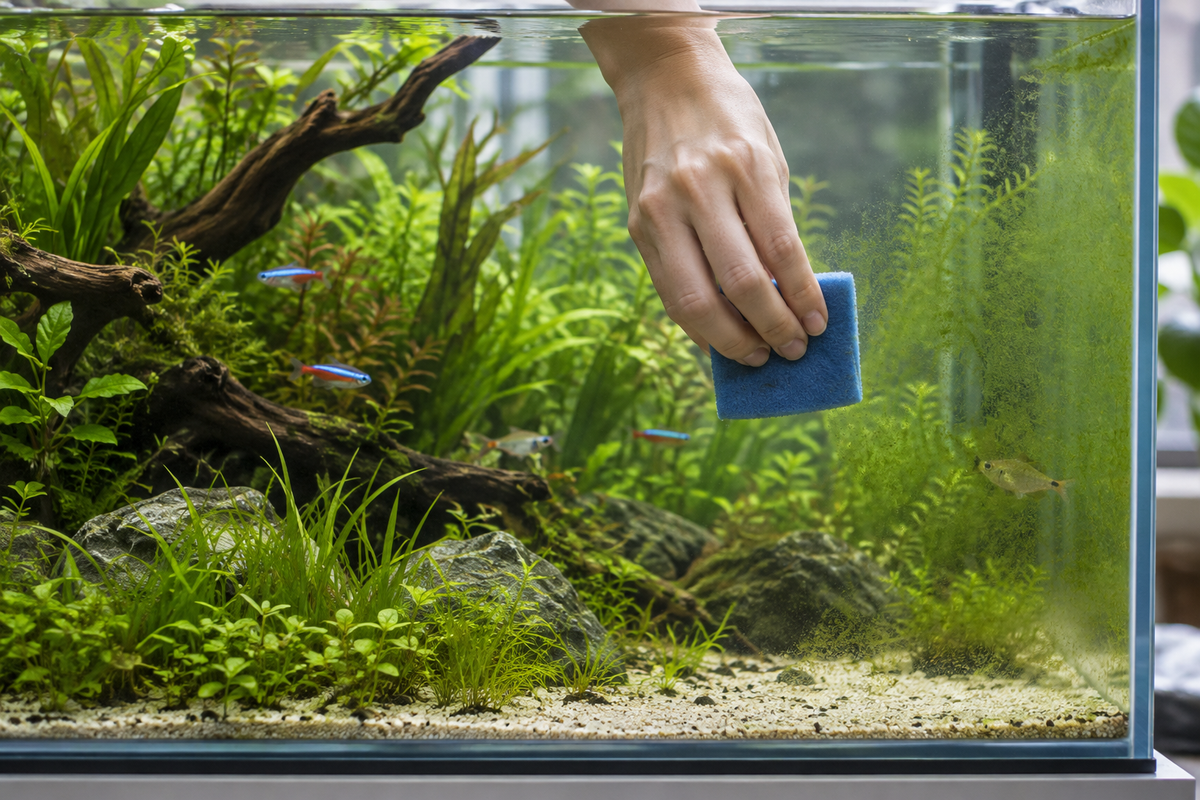
A green haze on the front glass is enough to obscure the colors of the fish and the details of the plants. To regain a clear view, it is generally not necessary to empty the aquarium. Mechanical cleaning with a compatible, clean tool, used away from grains of sand allows you to remove common deposits.
The first choice is made before touching the surface: is your aquarium made of glass or acrylic? This difference determines which tools can be used. A cleaner that is effective on glass can damage a synthetic material.

Identify the surface and the deposit
Consult the manual or the aquarium's model number to determine the material. Do not rely solely on its transparency or shape. biOrb aquariums, for example, use acrylic and require accessories compatible with that surface.
Next, observe the deposit. A soft film often comes off with a suitable pad. Small encrusted green spots sometimes require a different tool. A white mark near the water line may be a mineral deposit. An existing scratch, on the other hand, will not disappear just because you scrub harder.
Before you persist, also gently clean the outside with appropriate equipment: an external fingerprint can make it look like the dirt is in the water. This simple check avoids unnecessary work on the inside.
Choose the right tool for glass
The JBL Blanki is a cleaner intended for glass surfaces. Its documentation states that it is not suitable for plastic panes. It allows you to remove deposits with controlled movements, provided you keep the pad free of sand and gravel.

For more stubborn deposits, the JBL Aqua-T Handy has a stainless steel blade. Check its compatibility with the surface and follow the indicated movements. Keep the blade away from the seams and do not try to get under the silicone.
A magnet can facilitate regular maintenance when the model matches the material and thickness of the wall. Always check its inner face before using it. If it falls into the substrate, remove and clean it before resuming: sliding it directly against the glass can drag abrasive grains along.
For acrylic, stick to the intended accessories
The biOrb cleaning pads are designed for the maintenance of the acrylic in these aquariums. They have two sides intended for different levels of soiling. Use them as indicated, starting with the side and the gentlest movement suitable for the deposit.
Do not apply recommendations for glass: a blade or metal pad intended for glass is not automatically suitable for acrylic. Also check with the tank manufacturer regarding any special coatings.
A product intended for polishing the exterior must not be applied to the inside of a filled aquarium. biOrb specifically notes that its fine scratch and polish corrector is aimed at the exterior surface. For an internal scratch, ask the manufacturer for a suitable procedure before attempting anything.
Prepare for the task in a few minutes
- Set aside a tool reserved for the aquarium, a towel, and a clean container.
- Remove rings or accessories that might touch the surface.
- Ensure hands are free of cream, soap, or household product residues.
- Follow electrical safety guidelines for the aquarium and equipment before putting your hands in the water.
- If a water change is planned, prepare the equipment and replacement water before starting.
A kitchen sponge that has already been used may contain unwanted substances. Even when new, it is not necessarily designed for an aquarium. Dedicated tools avoid this uncertainty and allow you to know their scope of use.
Cleaning the inside, step by step
1. Start with an accessible area
Choose a part of the glass away from the bottom and the seams. Move the tool without excessive pressure, following the movements specified in its instructions. If the deposit resists, stop to identify its nature and check the tool. Repeated scrubbing without a proper diagnosis increases the risk of damaging the surface.
2. Work in small sections
Work methodically on the front, then on the sides if necessary. Check the pad between sections and rinse it in a suitable container when particles accumulate. Fish can generally remain in the tank during routine maintenance done calmly; avoid trapping them between the tool and decorations.
3. Keep a margin near the substrate
The bottom of the glass requires special attention. Do not push the tool into the sand. Use a compatible accessory that allows for precise movement without trapping grains between its surface and the wall. If in doubt, remove the tool to inspect it before continuing.
4. Respect the seams
Approach the silicone areas with a suitable accessory and without scratching the seam itself. A deposit at the edge of the seal does not justify cutting or running a blade underneath. If the seam seems to be peeling or degrading, have the aquarium examined: this is a problem distinct from algae cleaning.
5. Remove detached waste
When a partial water change is planned, siphon the accessible particles without disturbing the entire substrate. On a biOrb, the biOrb substrate cleaner is an accessory designed for removing water and waste according to its instructions. For other aquariums, choose a siphon suitable for your volume and substrate.
Should you clean the filter at the same time?
Cleaning the glass does not automatically require a complete disassembly of the filter. If the flow remains correct and biological maintenance is not necessary, avoid grouping all heavy tasks on the same day.
If the pre-filter has trapped many particles, check its condition and follow the manufacturer's procedure. Preserve the biological media that are still useful. After reassembly or restarting, check the circulation, seals, and equipment operation.
The goal is to make the view pleasant while maintaining a stable system. A clean window does not require sterilizing decorations, the substrate, and all filter media.
What to do about white marks at the water line?
Mineral deposits can be more resistant than algae films. In an occupied aquarium, do not pour in household descaler and do not spray any product on the rim. Liquid can drip into the water or reach equipment.
Start with a mechanical method compatible with the surface. If that is not enough, ask the manufacturer for a suitable procedure, which may require separate treatment of a removed element or an empty tank. Do not apply a cleaning recipe intended for a non-animal container into the water.
Limit the quick return of deposits
A light haze on the glass is a normal part of life in many aquariums. If algae return very quickly, examine the lighting duration and intensity, exposure to sunlight, feeding habits, and plant growth. Note any recent changes before modifying several settings at once.
Water tests help complete this observation. The CombiSet Plus NH4 includes nitrates, but not phosphates: check which parameter you need before purchasing. An anti-algae treatment does not replace removing the deposit or finding its cause.
Do not choose a fish or snail solely as a "cleaner." Every animal has specific needs regarding volume, diet, and compatibility. Its introduction must be part of your population plan.
A routine that is easy to maintain
Light and regular cleaning is often easier than heavy scrubbing after a long accumulation. Adapt the frequency to your observation of the tank, store the clean accessories, and check their condition before each use.
To choose the right tool, consult the JBL Blanki for glass or the biOrb pads for acrylic. If in doubt, send Aquiflor the aquarium's model number and a photo of the deposit before you persist.
Sources
- JBL — Blanki, compatibility and precautions regarding sand.
- biOrb — pads suitable for acrylic.
- biOrb — external use of the polishing product.
- OATA — aquarium maintenance; Aquishop data sheets for the mentioned tools.