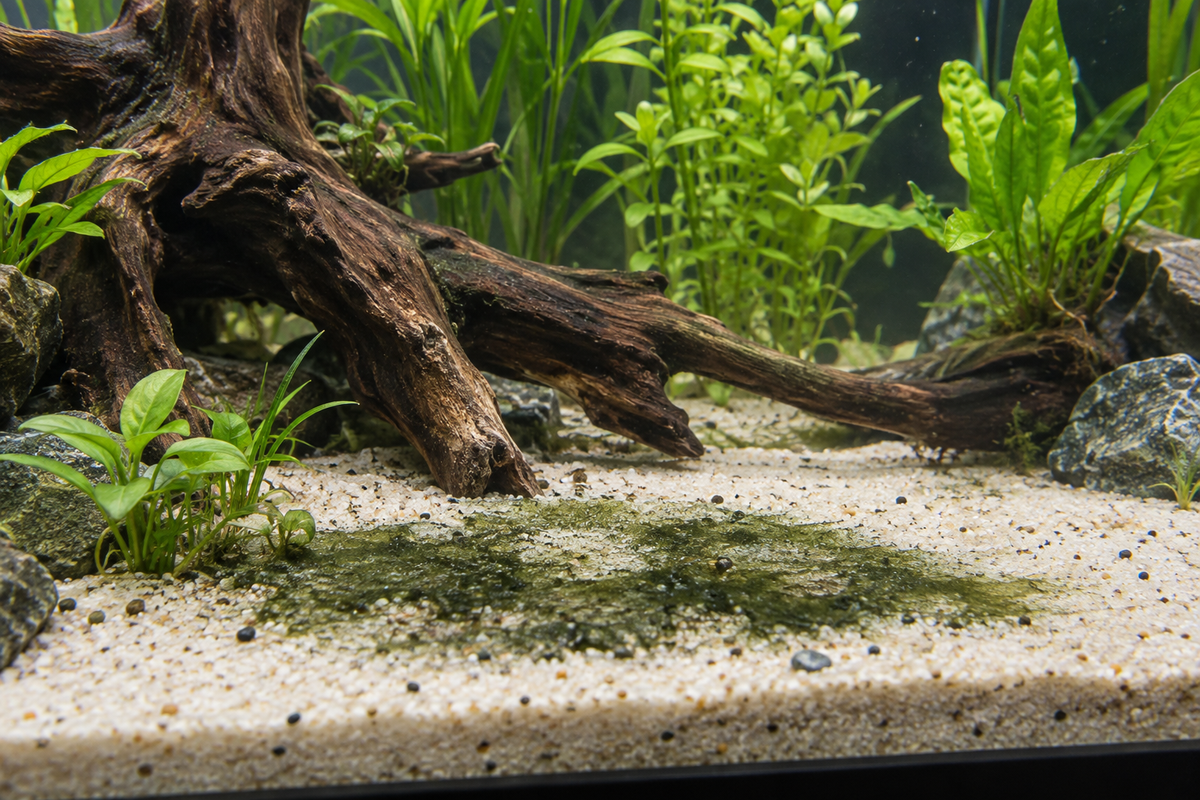
A green film covers the sand in the aquarium. You remove it, but it returns to the same spot. Before looking for an anti-algae product, you must understand the form of this deposit and the conditions under which it appears. A haze on the glass, long threads, and a slimy sheet are not treated in the same way.
When faced with "slimy green algae," start by documenting the problem, measuring the water, and checking the tank's maintenance. Targeted intervention helps protect the fish, plants, and biological filtration while you search for the cause.

Describe the deposit before naming it
Look to see if it forms actual filaments or a continuous layer. Specify its color, its location, and the speed at which it reappears after removal. Photos taken in the same place and with the same lighting make it possible to track its spread.
Cyanobacteria can produce slimy sheets sometimes called "blue-green algae." This name is misleading: they are photosynthetic bacteria, and their appearance is not always blue. Other deposits and associations of organisms may resemble them.
A photograph can help guide the diagnosis, without always confirming it. If the deposit quickly covers the plants or recurs despite consistent maintenance, have the situation examined before using multiple products.
Check the condition of the inhabitants first
Observe their breathing, swimming, and appetite. A fish that remains unusually at the surface or shows accelerated breathing requires prompt attention. Several causes are possible: the visible deposit is not necessarily responsible.
Check the filter operation, surface movement, and temperature. In case of concerning signs, quickly check ammonium/ammonia and nitrites and ask for advice. Correcting water quality can be more urgent than cleaning the decor.
Avoid adding new animals as long as the problem is not understood. Buying "cleaner" fish or shrimp to consume an unknown sheet creates a new maintenance burden without guaranteeing a result.
Reconstruct recent changes
A problem that appeared right after an intervention deserves a look back at that intervention. Did you replace all the filter media, move a large root, change the light fixture, or add many fish? A recent event provides a lead, without constituting proof on its own.
Also note more subtle changes: food distributed by several people, a misaligned timer, prolonged filter stoppage, modification of fertilizers, or sunlight hitting the tank in a different season.
Gather this information before further modifying the setup. If you change the lighting, fertilization, filter, and three products simultaneously, it becomes difficult to understand what improved or worsened the situation.
Perform analyses adapted to the aquarium
Measurements are used to monitor the living environment and examine certain nutritional leads. pH, KH, nitrogen compounds, and, depending on the case, phosphates provide complementary information. Compare the results to the needs of your population and the conditions of your planting.
The JBL ProAquaTest CombiSet Plus NH4 includes pH, KH, nitrite, nitrate, and ammonium tests, with ammonia interpretation according to the manufacturer. The phosphate test is not included. A complementary analysis can therefore be useful when you are examining nutritional inputs.
Also test the replacement water if you suspect it is introducing certain elements. Record the values with their units. An isolated result does not make it possible to identify a cyanobacterium, and a low nitrate value does not prove that the tank necessarily lacks fertilizer.
Examine the area where the deposit returns
Recurrence in the same spot invites you to look at the decor and local circulation. Do food scraps settle behind a root? Does a damaged leaf get stuck against the sand? Is the strainer or pre-filter clogged?
Remove accessible waste and check the actual flow rate. The goal is circulation adapted to the animals and plants, without turning the tank into a violent current. Simply moving the outlet can sometimes improve water distribution, but it must be evaluated within your setup.
Do not turn over the entire substrate to inspect a small area. Some substrates require specific maintenance. A superficial and progressive intervention avoids destabilizing the planting unnecessarily.
Remove deposits during controlled maintenance
When removal is appropriate, vacuum the visible materials with a siphon adapted to the tank's volume, without starting the flow by mouth. Monitor the water level and small animals. Prepare the replacement water before starting.
A brush used without suction may simply disperse the fragments. Work on one area at a time and observe the result. Remove heavily degraded leaves when keeping them no longer provides any benefit to the plant.
Cleaning the deposit does not justify the simultaneous replacement of all biological media. For ordinary maintenance, preserve the colonized filter media and follow the filter's instructions. Biological operation must remain a priority.
Properly prepare new water

The JBL Biotopol for freshwater aquariums can be used to condition new water according to the manufacturer's indications. Adapt the quantity to the volume concerned and check the temperature as well as the compatibility of the added water's parameters.
The proportion and frequency of water changes depend on the situation. Avoid an improvised complete emptying. If substances dangerous to fish are detected, ask for a corrective protocol adapted to the results and the population.
Should you turn the aquarium off completely?
A period of darkness is sometimes proposed against cyanobacteria. This protocol requires sufficiently solid identification and precise organization: duration, maintenance of the filter, oxygenation, monitoring, and maintenance after intervention.
Do not simply cover the tank by cutting all equipment. Darkness acts on photosynthetic organisms, including plants, while animals and filtration still have their needs. Have the method validated for your setup before undertaking it.
Why not choose an anti-algae product at random?
JBL indicates in its documentation that Clearol and classic anti-algae products are not a reliable response to cyanobacteria. The manufacturer also notes a possible sensitivity of shrimp, especially dwarf species, to Algol. These details show why the product name and its compatibility must be verified.
Avoid improvised mixtures, copper recipes, and the use of antibiotics for a decor problem. A product intended for an outdoor pond does not become suitable for an aquarium simply by reducing the dose.
If a product is chosen after diagnosis, read its current instructions and prepare the follow-up. Note the actual volume treated, other products used, and the animals present, including invertebrates.
Monitor improvement without promising a fixed deadline
After maintenance, photograph the area and note useful measurements. Look to see if the deposit returns, if it spreads to other supports, and if the plants resume normal growth. A clean surface for a few hours is not enough to draw a conclusion.
To obtain a precise opinion, send the Aquiflor team the tank volume, its start date, its population, the analyses, and two photos of the deposit. Add any recent interventions. You will then be able to choose the next steps based on concrete elements.