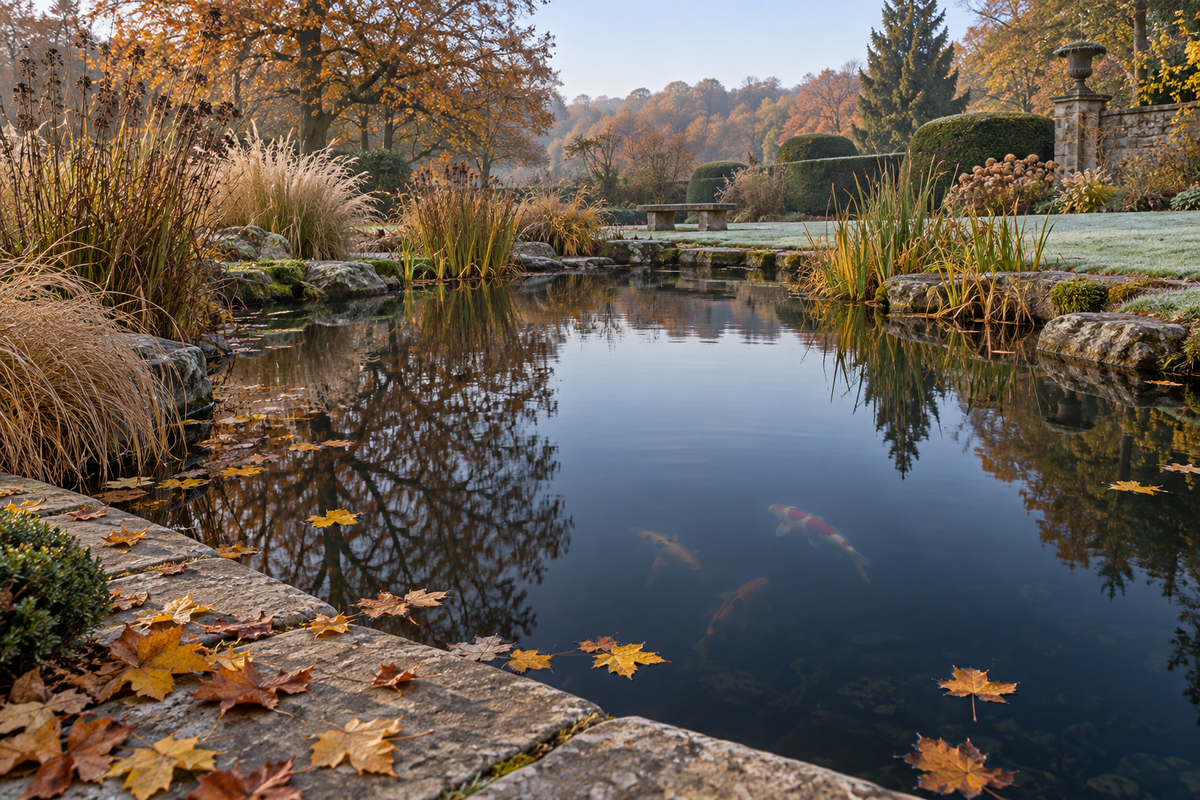
Leaves are starting to fall, fish are eating more slowly, and the water temperature is dropping. Now is the right time to prepare for winter, before the frost makes interventions complicated. The goal is simple: limit waste, protect equipment, and maintain suitable conditions for the pond's inhabitants.
Preparing a pond for winter is done gradually. A pond without fish, a small ornamental basin, and a heavily equipped koi pond are not managed in the same way. These seven steps provide a method to adapt to your setup, the user manuals, and the local weather.

1. Assess the pond before touching the equipment
Start with a complete tour: water level, fish behavior, return flow, condition of the pipes, and waste accumulation. Note any recent changes. A pond that is already losing water or whose filter is overflowing needs to be addressed before the cold weather sets in.
Check the water temperature and track its trend over several days. For a fish pond, also check the useful parameters, especially pH, KH, ammonium/ammonia, and nitrites. The JBL ProAquaTest CombiSet for ponds brings together several of these analyses; oxygen measurement requires a separate test or device.
Keep the results with the date and time. This baseline will be useful if the fish change their behavior or when starting up again in the spring. Clear water can contain problematic substances: its appearance alone does not validate winter readiness.
2. Intercept leaves before they accumulate at the bottom
Collecting a few leaves from the surface takes less time than removing a layer of submerged debris. Use a net regularly and check the skimmer basket when it is running. After a windy spell, a new visit to the pond is often necessary.
If there is significant leaf fall, a net can make maintenance easier. The OASE Aquanet 1 measures 3 × 4 m and includes pegs. Before choosing the size, measure the pond and provide for fixing margins: a net with the exact dimensions of the surface will not always be easy to tension.

Avoid letting it sag under their weight. Also, check that animals cannot become trapped, especially near the banks and usual crossing points. In a natural pond, a few leaves are part of the environment; the goal is to manage excessive buildup, not to remove every piece of vegetation.
3. Evaluate sludge and choose a proportional intervention
Observe several areas of the bottom. Is the deposit mainly made up of fresh leaves? Soft organic sludge? Soil washed in by runoff? These situations do not call for the same response. Identify the affected areas and the source of the deposits before starting.
Remove accessible deposits with a PondoVac
For an accessible ornamental pond, a PondoVac 4 allows for targeted suction. The PondoVac 5, with its built-in discharge pump, can be more practical depending on the discharge layout. Check depth, access, circuit length, and discharge point before choosing.
Work in sections without stirring up the whole pond. Monitor the water removed and, if necessary, prepare a top-up that is compatible with the fish. In a pond rich in wildlife, preserve refuges and avoid complete scraping of the bottom.
Incorporate Aquipond Bactovase into the maintenance program
Aquipond Bactovase targets the organic fraction of sediments. The data sheet specifically provides for an application program in the spring and autumn. The product settles on the sludge, and its action depends on environmental conditions and the nature of the deposit.
Follow the current instructions for dosage and application conditions. Do not expect it to make sand disappear or guarantee a reduction of the entire measured thickness. Plan this work early enough to be able to follow the progress, rather than applying a product the day before a frost without control.
4. Prepare plants without removing all shelters
Remove parts that are breaking down in the water and truly excess vegetation. Bank plants that are still standing can remain of interest to small wildlife. The RHS advises postponing the pruning of certain unweakened stems until the end of winter.
Then check the hardiness of each plant. A hardy water lily and a tropical plant are not protected in the same way. Frost-sensitive species must be taken indoors according to their needs, with suitable humidity and light. Keep the labels to avoid making decisions based solely on the appearance of the leaves.
Do not reflexively move all baskets to the bottom. The winter depth must remain compatible with the species and the pond's configuration. If you divide a plant or work on a bank, limit the disturbed area and inspect the removed vegetation.
5. Adjust meals to temperature and appetite
With cooling temperatures, the dietary needs of koi and goldfish change. Gradually reduce quantities and observe what is actually consumed. Leftovers must be removed. An automatic feeder set for summer can continue to unnecessarily burden the pond if you do not reprogram it.
A transition food such as the Aquifood Wheat-Germ floating 3mm is presented for spring and autumn. Its data sheet recommends introducing it when the water temperature drops below 15°C. This does not mean you should feed without limits throughout the winter.
For stopping meals, follow the food guidelines and the needs of the species present. Do not insist if the fish are no longer feeding. A water problem or abnormal behavior also requires a check. Species with special needs, such as sturgeons, require a specific program: do not automatically apply the koi program to them.
6. Decide on the winter operation of each piece of equipment
Make a list: filtration pump, filter, UV, waterfall, aerator, and potential heater. For each, look for the wintering instructions for the exact model. The frost resistance of a pump does not automatically protect the accompanying pipes, fittings, and filter housing.
If a circuit remains in operation, check its frost protection and what would happen during a power outage. A waterfall can divert water out of the pond when ice forms. Regularly check the level, even if the pump noise seems normal.
If an piece of equipment needs to be shut down, follow its draining, cleaning, and storage procedure. Photograph the connections and label the disassembled parts. Do not store all devices in the water as a rule: the method depends on the equipment.
For a fish pond, stopping filtration must be integrated into the management of the population, feeding, and water. Do not choose a single date like November 1st to unplug everything. A system designed to operate in winter and an exposed, unprotected filter impose different decisions.
7. Plan for gas exchange and monitoring during frost
In a fish pond, a lasting ice cover can limit gas exchange with the air. A suitable device can maintain a local opening. Its choice depends on the climate, depth, and conditions specified by the manufacturer.
A surface de-icer does not necessarily heat the entire pond. Similarly, a small aerator does not make any shallow pond suitable for wintering fish. Prepare the equipment location according to its manual, without improvising intense churning of the bottom.
Do not hit the ice to open a hole. The RHS advises against this practice because of the vibrations transmitted into the water. Work from a stable bank and never step on the pond ice. A natural pond without fish does not automatically require the same devices as a koi pond.
A checklist for the cold weeks
Once preparation is complete, keep a short routine. It is mainly about verifying that the pond continues to function as expected.
- After wind: check leaves, the net, and water inlets.
- After a frost: check the level, exposed pipes, and the opening maintained by the intended device.
- During a thaw: measure the water before resuming feeding habits.
- In case of unusual behavior: quickly check the water and equipment, then seek advice if the problem persists.
Leave this sheet with the person who will monitor the garden during an absence. Add a photo of the devices, their role, and useful contact details. A few precise indications prevent random manipulations.
Preparing for winter in the right order
Start by intercepting leaves and assessing deposits. Then choose targeted suction or biological maintenance as needed, then check the wintering of your setup.
View the PondoVac 4 to remove deposits →
Discover Aquipond Bactovase →
Sources
- RHS — Pond maintenance in October: leaves and plants.
- RHS — Pond maintenance in January: ice and monitoring.
- RHS — Wildlife ponds: measured pond maintenance.
- OASE — Preparing the pond and water features for winter: equipment protection, to be supplemented by the model's manual.
- Hikari — Feeding your coldwater fish: adapting feeding to activity, water, and temperature.
- Aquipond — Bactovase: action on organic matter.
- Aquishop data sheets for Aquanet 1, PondoVac 4, PondoVac 5, Bactovase, and Aquifood Wheat-Germ.