
You are adding clay to your pond: should you turn off the pump? Stop the filter? Turn off the UV? Not necessarily. And above all, do not automatically cut off all filtration.
The pump, biological filter, and UV-C device do not have the same role. The right method depends first and foremost on the product used, its composition, and the manufacturer’s recommendations.
Pure mineral clay, such as a Bactoclay Aquipond Montmorillonite type clay, is not necessarily used the same way as a product combining clay, minerals, and bacteria.
Here is how to avoid mistakes.

Pump, filter, and UV: three different functions
We often talk about "turning off the filtration," whereas a pond generally includes several distinct pieces of equipment.
The pump
The pump ensures water circulation. It generally supplies the filter, but sometimes also a waterfall, a stream, or another circuit.
If you stop it, you are therefore also interrupting an important part of the pond's circulation and oxygenation.
The filtration
The mechanical part of the filter traps particles present in the water.
The biological part, meanwhile, houses the microorganisms that participate in the transformation of nitrogenous waste.
When very fine clay is added to the water, some of the particles and matter it associates with can gradually be captured by this filtration.
The UV-C
The UV-C acts only on the water that passes through its chamber.
Therefore, one should not confuse turning off the UV with stopping water circulation.
On many installations, the pump can perfectly well continue to operate while the UV is turned off.
👉 Before using a treatment, always check which equipment is controlled by which socket. Labeling the cables for the pump, UV, and aeration can save you a lot of mistakes later on.
Not all pond clays are identical
This is probably the most important point.
The word "clay" on packaging is not enough to know how to use the product.
Some preparations consist essentially of mineral clays rich in montmorillonite. Others combine several minerals, zeolite, or even bacteria.
You must therefore reason product by product.
| Product used | To check | To avoid |
|---|---|---|
| Mineral pond clay | Dosage, dispersion, frequency of use | Automatically turning off all filtration |
| Clay + bacteria | Recommendation regarding UV | Applying the instructions of another brand |
| Several simultaneous treatments | Compatibility between products | Mixing several products "to go faster" |
| Product without clear instructions | Exact reference and manufacturer information | Improvising the dosage |
Simply looking for mineral clay for your pond?
The Aquishop catalog offers Aquipond BactoClay, a natural clay very rich in montmorillonite and specially selected for ponds and koi ponds.
It helps provide minerals to the water while being easily integrated into the regular maintenance of the pond.
→ Discover Aquipond BactoClay 2 kg

And in the case of BactoPlus Ohmizu Clay?
BactoPlus Ohmizu is a good example of a product that shows why one should avoid overly general rules.
It is not just a clay: its formulation combines minerals, zeolite, and bacteria in particular.
For BactoPlus Ohmizu Clay, the Aquishop product sheet indicates that the pump and UV can remain in operation during use.
It would therefore be useless to systematically advise turning off the entire installation for 24 or 48 hours.
On the other hand, if your packaging indicates a different recommendation, the instructions for the product you actually have in your hands take priority.
Keep a photo of the label if possible: this makes it easy to verify the exact reference in case of doubt.
The official Aquadistri presentation confirms a combination of minerals and bacteria; it does not specify, on the page consulted, any UV shut-off duration. The operational guideline reported here comes from the Aquishop sheet. If it differs from your packaging, have the procedure confirmed before application.

The water becomes cloudy after adding clay: is this normal?
Yes, this can happen.
A very fine clay disperses throughout the water column and can temporarily cause a whitish or grayish veil.
This does not necessarily mean that your filtration is working poorly.
The right reaction is rather to observe:
the filter flow rate;
the condition of the foam or mechanical filtration;
the progression of transparency;
the behavior of the fish;
the exact quantity of product added.
Above all, avoid immediately adding a second dose simply because your pond still appears cloudy.
More clay does not necessarily mean a faster result.
Let the product and the filtration work according to the intended recommendations.
However, fish that are breathing abnormally, huddling at the surface, or abruptly changing behavior require a quick check of the water and aeration. Do not consider any reaction after an addition to be normal. A mineral supplement does not replace testing or professional advice when fish show worrying signs.
Why use clay in a pond?
A pond clay can be chosen for different objectives, to be examined according to its composition and water needs.
Clays rich in montmorillonite are particularly interesting for their mineral richness and exchange capacity.
They can also interact with very fine particles present in the water, which can then be gradually eliminated by the filtration system.
It is for this reason that we generally prefer to consider clay as a regular pond maintenance product, rather than as a miracle treatment used only when a problem appears.
Our choice for regular mineral maintenance
For owners looking primarily for a highly concentrated mineral clay, Aquipond BactoClay contains a high proportion of montmorillonite and has an extremely fine particle size allowing for its dispersion in the pond.
For a product combining clay, minerals, and bacteria, BactoPlus Ohmizu constitutes a different approach.
The choice therefore depends primarily on what you wish to provide to your pond.
Should you turn off filtration to keep the clay in the water longer?
This reasoning seems logical: if the clay stays in suspension longer, it should act more.
But this is not necessarily the case.
Water circulation is precisely what allows the product to be distributed throughout the entire pond. The mechanical filtration will then be able to gradually collect some of the particles and suspended matter.
Stopping circulation completely simply to keep the water cloudy longer is therefore not a strategy to be applied systematically.
Above all, follow the recommendation of the product used.
How to properly add clay to your pond?
The exact method depends on the manufacturer, but a few principles help avoid the majority of errors.
Calculate the actual volume of your pond.
A 20 m² pond does not necessarily contain 20 m³. The average depth significantly changes the actual volume.
Respect the product dosage.
Do not double the dose to get a faster result.
Distribute the clay correctly.
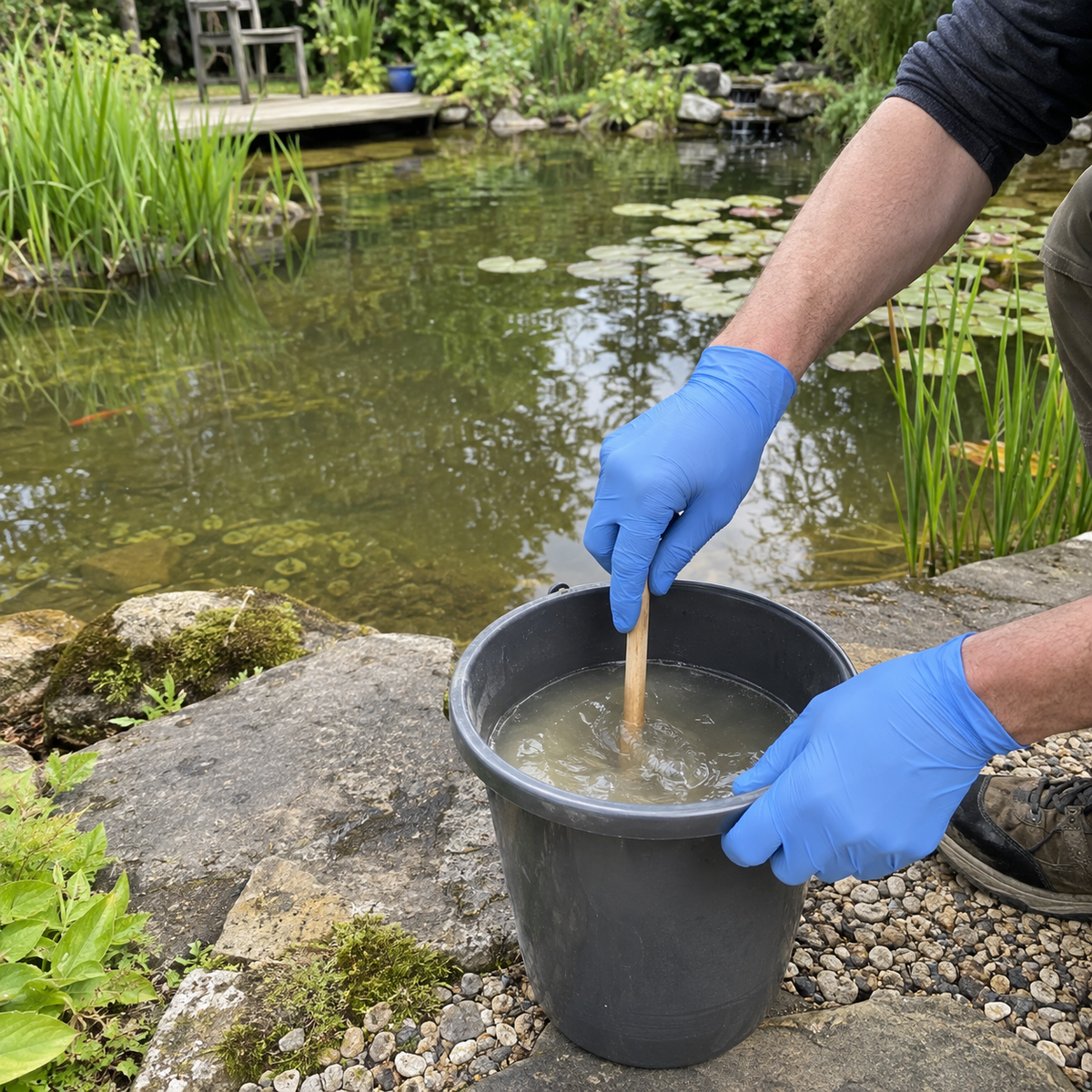
According to the product recommendations, it can be pre-mixed in a bucket of water to facilitate its dispersion.
Maintain good circulation.
Unless otherwise indicated by the manufacturer, circulation allows the product to be properly distributed.
Monitor your mechanical filtration.
The trapped fine particles can temporarily increase the load on the filter.
Wait before repeating the application.
Give the product enough time to work.
💡 Aquishop tip: for regular maintenance, it is generally better to use a quality clay in a reasoned and repeated manner than a very large quantity added sporadically.
Before modifying an electrical control
Locate the circuits and consult the device manuals. A compact assembly does not always allow for managing each function separately. When a flow shut-off is necessary, pay special attention to the UV-C instructions and the restart conditions. Do not handle connections with wet hands and never look at a UV-C lamp turned on outside of its protective housing.
Dosing a powder with the right unit
The volume of the pond and the unit in the instructions must be known. Grams and milliliters are not automatically equivalent. If a data sheet and your packaging give contradictory units, have the quantity clarified before use. Avoid creating a powder cloud, respect handling precautions, and keep the product dry.
Can you add clay when the water is already cloudy?
Yes, but you must first understand why the water is cloudy.
Clay is not a substitute for a diagnosis.
Cloudy water can notably come from:
fine particles in suspension;
a saturated mechanical filter;
potting soil escaping from baskets;
organic matter;
runoff after heavy rain;
a proliferation of unicellular algae;
a problem with balance or filtration.
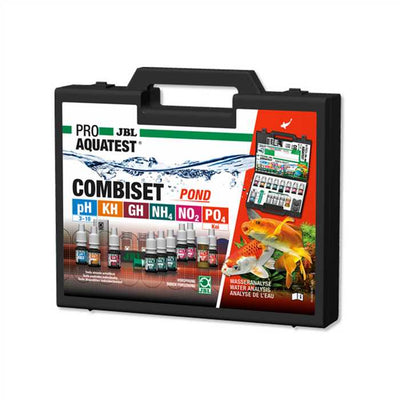
Before adding several treatments successively, check your installation and, if necessary, the main water parameters.
→ Checking pond water parameters helps choose appropriate maintenance.
Clay and koi: why is it used so much?
Clays rich in montmorillonite have long been popular with koi carp enthusiasts.
The goal is not to "treat" the fish, but rather to work on their environment: water quality, availability of certain minerals, and management of fine particles.
It is precisely with this logic that Aquipond BactoClay was developed, with a highly purified volcanic clay particularly rich in montmorillonite.
If you regularly maintain a koi pond, clay can therefore become a full-fledged maintenance product rather than a solution that is only brought out when the water turns cloudy.
→ Discover BactoClay for the maintenance of koi ponds
Frequently asked questions
Should I turn off the pump when I add clay?
Not automatically.
In many cases, maintaining circulation allows, on the contrary, for the clay to be correctly distributed throughout the entire pond.
Always refer to the indications for the product used.
Should I turn off the UV during a clay treatment?
It depends on the product.
An exclusively mineral clay and a preparation also containing microorganisms do not necessarily need to be used in the same way.
For BactoPlus Ohmizu Clay, the Aquishop sheet indicates that the pump and UV can remain in operation.
My pond becomes white after adding clay. Is it serious?
A slight veil can be perfectly normal after the dispersion of a very fine powder.
Observe its progression before intervening or adding a new dose.
Can I use any clay or bentonite?
We advise against it.
Prioritize a product whose composition, purity, and pond use are clearly documented.
A clay sold for gardening, construction, pottery, or another use is not automatically suitable for a pond containing fish.
Can I add clay every week?
It depends on the dosage and frequency recommended by the manufacturer.
For regular maintenance, always respect the intended quantities rather than increasing the number of applications.
Things to remember
No, you should not automatically turn off the pump, filter, and UV when adding clay to your pond.
Remember above all:
identify precisely the product used;
distinguish a mineral clay from a product also containing bacteria;
respect its dosage;
do not turn off circulation unnecessarily;
monitor your filtration after application;
do not increase treatments without knowing their compatibility.
For BactoPlus Ohmizu Clay, the pump and UV can remain in operation according to the indications currently listed on our product sheet.
And if you are looking for mineral clay rich in montmorillonite to integrate into the regular maintenance of your pond, discover Aquipond BactoClay 2 kg.
A doubt about the dosage or your installation? Contact the Aquiflor team with a photo of the label, the pond volume, and the filter reference. These elements allow us to verify the appropriate method.
Sources
Aquadistri — BactoPlus Ohmizu: composition based on minerals and bacteria.
Microbe-Lift — Calcium Montmorillonite Clay: manufacturer presentation on montmorillonite and suspended particles.
Aquadistri — Koi Pro Filtration: mechanical and biological functions.